

Heated Work Boots With CSA Z195: A 2026 Guide
Table of Contents
- What CSA Z195 Means and Why It Matters for Heated Work Boots
- Waterproof Winter Work Boots: The Foundation for Heated Footwear
- Heated Work Boots Battery Life: What a Full Shift Requires
- ASTM F2413 Work Boots: Understanding the Safety Standard
- Steel Toe and Composite Toe Protection in Heated Boots
- Selecting the Right Heated Work Boot for Your Job
- Care, Maintenance, and Safety Considerations
- Frequently Asked Questions
Last Updated: October 14, 2026
What CSA Z195 Means and Why It Matters for Heated Work Boots
CSA Z195 is the Canadian safety standard that certifies protective footwear like heated work boots CSA Z195 for hazardous work environments. If you work in construction, utilities, oilfield operations, or any industrial setting in Canada, this certification isn't optional, it's the baseline requirement that separates compliant safety gear from unregulated alternatives.
The standard covers impact protection, compression resistance, electrical hazard protection, and metatarsal guard requirements. When you see the CSA Z195 marking on a boot, it means that boot has been independently tested and verified to meet specific protective thresholds.
How CSA Z195 Differs From ASTM F2413
Many workers assume CSA Z195 and ASTM F2413 are interchangeable standards. They're not. ASTM F2413 is the U.S. standard, while CSA Z195 is the Canadian equivalent. The testing protocols differ, the protective thresholds vary, and equipment certified under one standard may not meet the other.
The key difference: CSA Z195 includes specific electrical hazard classifications (EH rating) that are more stringent than ASTM F2413 in certain applications. If you're working near electrical equipment or in environments with electrocution risk, CSA Z195 compliance is essential. ASTM-certified boots alone won't provide the same protection in Canadian workplaces.
Verifying CSA Z195 Markings on Your Boots
Don't assume a boot is CSA Z195 certified just because it looks industrial. Verify the certification yourself. Look for the CSA mark, a distinctive logo, printed or embossed on the tongue, heel, or insole of the boot.
If the marking is missing, worn off, or unclear, contact the manufacturer directly. E-BOOTS™ provides certification documentation with every pair, so you can verify compliance before your team wears them on site. This matters because non-compliant footwear can expose your company to liability and workers to genuine injury risk.
Waterproof Winter Work Boots: The Foundation for Heated Footwear
Heated boots only work effectively when moisture stays out. Waterproofing isn't a luxury feature, it's the foundation that keeps heating elements functioning and prevents your feet from becoming colder as sweat and external moisture accumulate inside the boot.
Most heated work boots use sealed seams and water-resistant uppers, but the real protection comes from the insole and heel construction. If water enters through the sole or heel, the heating system can't compensate for the cooling effect of moisture.
E-BOOTS™ integrates rugged waterproof construction with active thermal management, so the heating system maintains consistent warmth even in wet conditions.
Heated Work Boots Battery Life: What a Full Shift Requires
This is where many workers get disappointed. They've tried heated insoles or cheap heated socks that died after three hours, leaving them in the cold for the rest of their shift. The difference between those failures and reliable heated work boots comes down to battery capacity, heat settings, thermal efficiency, and how the system behaves in real cold.
Heat Settings and the Runtime Trade-Off
Almost every heated boot on the market offers more than one heat setting, typically low, medium, and high, sometimes with finer app-based control. The setting you choose is the single biggest factor in how long the battery lasts.
A common pattern across heated footwear is that low setting roughly doubles or triples runtime compared to high setting. If a boot claims 8 hours on low, expect something closer to 3-4 hours on high. That's not a defect; it's physics.
What Actually Drains the Battery Faster
Battery runtime claims are usually measured in controlled conditions. Real job sites are harder on the system. The factors that shorten runtime most:
- Extreme cold. Lithium-ion batteries lose usable capacity as temperatures drop. A battery that delivers 8 hours at 20°C (68°F) may deliver noticeably less at -20°C (-4°F).
- High heat settings used continuously. Running on high all day is the fastest way to drain a pack.
- Wet conditions. Moisture wicking heat away from the boot forces the heating element to work harder to maintain the set temperature.
- Heavy socks and tight fit. Ironically, over-insulating can trap heat and cause the system to cycle, but a poor fit that lets cold air circulate can also increase draw.
- Battery age. Lithium-ion packs degrade over time. A pack that ran 8 hours when new may run 5-6 hours after a couple of seasons of regular use.
A realistic planning number for a full shift is to assume you'll get roughly 60-70% of the manufacturer's best-case runtime in genuine winter conditions. If that doesn't cover your shift, look for boots with replaceable batteries so you can carry a spare.
Charging: Time, Habits, and Safety
Charging behavior affects both runtime and battery lifespan.
- Charge time. Most heated boot batteries recharge in a few hours, often 3-5 hours for a full charge. If you only charge overnight, that's usually fine. If you're trying to top up between shifts, know the charge time before you buy.
- Use the supplied charger. Off-brand chargers can overcharge or undercharge the pack, and they may not have the same thermal cutoffs. This is a safety issue, not just a performance one.
- Don't charge a frozen battery. Let the boot and battery come up to room temperature before charging. Charging a cold pack can reduce capacity over time and, in some designs, create a safety risk.
- Don't charge unattended overnight on a flammable surface. Most systems are designed to be safe for overnight charging, but the general rule for any lithium-ion device applies: charge on a non-flammable surface, away from clutter.
Thermal Management and Battery Health
During charging, the battery and charging circuit will warm up. That's normal. What's not normal is a battery that becomes too hot to touch, a charger that smells like burning, or a boot that stays warm long after it's been unplugged.
For storage, the standard advice for lithium-ion packs applies: store at partial charge (not fully drained, not necessarily 100%), in a cool, dry place, and recharge every few weeks if the boots sit unused for months. Leaving a pack fully depleted for a long period is one of the fastest ways to kill it.
Cold-Weather Performance vs. Heat-Resistant Boots
One clarification that matters for anyone searching this topic: a heated boot is designed to keep your feet warm in cold conditions. A heat-resistant boot is designed to protect your feet from external heat, welding slag, molten metal, hot pavement, foundry work.
If your job involves both cold exposure and external heat hazards, you need to check whether the boot carries the relevant heat-resistant rating in addition to CSA Z195. Don't assume that because a boot is "thermal" it covers both directions.
Battery Replacement and Long-Term Ownership
Batteries are consumable. Even with good care, most heated-boot packs will lose meaningful capacity after a few seasons of regular use. Before buying, find out:
- Whether replacement batteries are sold separately.
- Whether the battery is user-replaceable or requires sending the boot in.
- Whether the same battery fits multiple models, so you're not locked into one boot.
A boot with a replaceable, widely available battery will outlast one with a sealed, proprietary pack, and it'll cost less to keep running over the life of the boot.
ASTM F2413 Work Boots: Understanding the Safety Standard
ASTM F2413 is the American standard for protective footwear, and many Canadian workers encounter it through cross-border equipment or companies with U.S. operations.
ASTM F2413 covers impact, compression, puncture resistance, and electrical hazard protection (F2413 Standard Specification for Performance Requirements for Protective (Safety) Toe Cap...). The testing methods are rigorous, and ASTM-certified boots are legitimate protective equipment.
If you work exclusively in Canada, prioritize CSA Z195 certification. If you work in both Canada and the U.S., or if your employer specifies ASTM compliance, verify that your boots meet both standards.
Steel Toe and Composite Toe Protection in Heated Boots
Steel toe boots are the traditional standard for impact protection. They're proven, affordable, and universally recognized. Steel toes meet or exceed CSA Z195 impact requirements and have decades of real-world performance data supporting them.
Composite toe boots offer an alternative. They're lighter, don't conduct cold, and perform equally well under CSA Z195 testing.
The choice depends on your work environment and personal preference. Both options, when properly certified, provide the protection CSA Z195 requires. The key is verifying that certification before you buy.
Selecting the Right Heated Work Boot for Your Job
Not all heated work boots suit every job. A rooftop worker in winter faces different hazards than someone working in a utility trench or on an oilfield rig. Matching the boot to your specific environment matters.
Rooftop Work and Extreme Cold Exposure
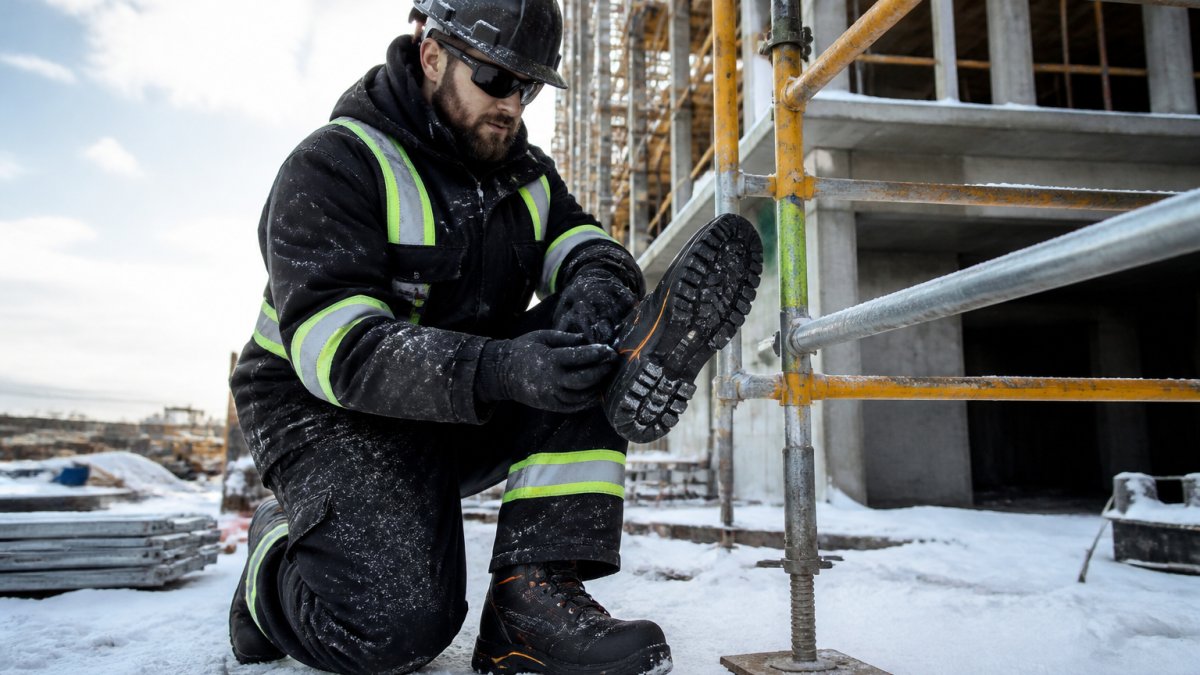
Rooftop work demands boots with exceptional traction and stability. You're working at height on surfaces that may be icy or slippery. The heating system is secondary to grip and ankle support. Look for boots with aggressive tread patterns and reinforced ankle support.
Extreme cold exposure, working outdoors for extended periods in sub-zero temperatures, demands maximum heating capacity from heated work boots CSA Z195. You need boots that can sustain high heat output for your entire shift without battery depletion. E-BOOTS™ heated work boots deliver consistent warmth with app-controlled adjustments, so you can maximize heat when conditions are harshest.
Service Work and Industrial Environments
Service technicians and industrial workers often move between heated and unheated spaces. Boots that can quickly adjust heat levels save battery life and keep your feet comfortable during temperature transitions.
Industrial environments also demand durability. Your boots will take abuse. Look for reinforced uppers, durable soles, and protection against chemicals and oils common in your workplace. CSA Z195 certification is non-negotiable because industrial hazards are real.
Care, Maintenance, and Safety Considerations
Heated work boots require more care than standard footwear because of the battery and heating elements. Proper maintenance extends their lifespan and keeps them safe.
Clean your boots after each shift. Remove snow, mud, and debris with a soft brush or cloth. For stubborn dirt, use lukewarm water and mild soap.
Inspect the CSA Z195 markings regularly.
Check the heating elements and battery compartment for damage before each use.
Store boots in a cool, dry place away from direct sunlight. Keep the battery charged during storage.
Selecting heated work boots with CSA Z195 safety rating requires understanding certification standards, battery performance, and job-specific hazards. E-BOOTS™ heated work boots integrate app-controlled heating technology with CSA Z195 and ASTM F2413 safety protection, delivering adjustable warmth and reliable stability for extreme cold conditions. Join the waitlist to secure your pair and experience the difference professional-grade thermal protection makes on demanding work.
Frequently Asked Questions
What does CSA Z195 mean on work boots?
CSA Z195 is the Canadian safety standard for industrial protective footwear. It certifies that heated work boots meet impact resistance, compression protection, and electrical-hazard requirements. CSA Z195 boots protect against puncture, heavy objects, and electrical shock in industrial environments. The rating ensures the boot's heating system does not compromise safety protection, making it essential for construction, utility, and oilfield work in cold conditions.
How long do heated work boots stay warm on a single charge?
Battery runtime for heated work boots depends on the heating level selected and external temperature. Most systems with active thermal management are designed for long-shift performance, though extreme cold or maximum heat reduces this. Always verify the specific battery specifications for your model before purchasing, as runtime varies significantly between brands and heating technologies.
Can heated work boots be waterproof and still meet safety standards?
Yes. Waterproof winter work boots that meet CSA Z195 and ASTM F2413 standards use sealed construction to keep moisture out while maintaining protective features. The heating elements are insulated to prevent water damage and thermal hazards. Waterproof design is essential in industrial work because wet feet lose heat rapidly, defeating the purpose of heated boots. Look for boots with sealed seams, treated leather, and insulated heating systems to ensure both protection and thermal performance.
How do I verify that work boots actually meet CSA Z195 requirements?
Check for visible CSA Z195 marking on the boot's tongue, heel, or sole. Request documentation from the manufacturer showing third-party testing results. Reputable brands provide certification details on their product pages or in packaging. Avoid boots claiming 'CSA-style' or 'CSA-inspired' protection, only boots with official CSA Z195 certification offer legal compliance. Contact the manufacturer directly if markings are unclear; legitimate brands can prove their certification status instantly.


