

App-Controlled Heated Safety Boots 2026: Buyer's Guide
Table of Contents
- What Are App-Controlled Heated Safety Boots?
- Heated Boots vs Heated Socks: Which Works Better for Cold-Weather Work
- App-Controlled Heated Boots: How Temperature Control Actually Works
- Heated Boots Battery Life: Runtime, Charging, and Real-Shift Performance
- Safety Certifications: Heated Safety Boots with CSA Z195 and ASTM F2413
- Key Features to Compare: Waterproofing, Insulation, and Heat Distribution
- Common Concerns: Safety, Privacy, and Long-Term Durability
- Frequently Asked Questions
Last Updated: October 14, 2026
What Are App-Controlled Heated Safety Boots?
App-controlled heated safety boots combine industrial safety protection with app-managed heating. Rechargeable batteries power built-in elements that workers adjust in real time from a smartphone, meeting standards like CSA Z195 and ASTM F2413 for extended shifts in freezing conditions.
Traditional insulation is static; app-controlled systems let you dial heat up or down, maximum at minus 20 degrees, lower indoors to preserve battery life. That flexibility is why construction crews, utility workers, search and rescue teams, and industrial workers rely on them.
Heated Boots vs Heated Socks: Which Works Better for Cold-Weather Work
Heated socks are smaller, lighter, and cheaper, sliding into any existing boot. Heated boots integrate heating into the footwear itself, delivering more consistent warmth and better safety integration.
During long shifts, heated socks can migrate or bunch, creating cold spots, and rely on the boot's insulation to trap heat. Heated safety boots engineer heat zones into the sole and upper, so coverage matches the boot's structure.
Battery life also favors integrated systems: heated boots distribute battery weight across the footwear structure, allowing larger capacity without bulk, while heated socks limit runtime on a single charge.
App-Controlled Heated Boots: How Temperature Control Actually Works
App-controlled heated boots link heating elements in the sole and upper, a rechargeable battery pack (usually in the heel or arch), and a smartphone app that sends commands over Bluetooth. You set a target temperature, and the system modulates output to hold it throughout the shift.
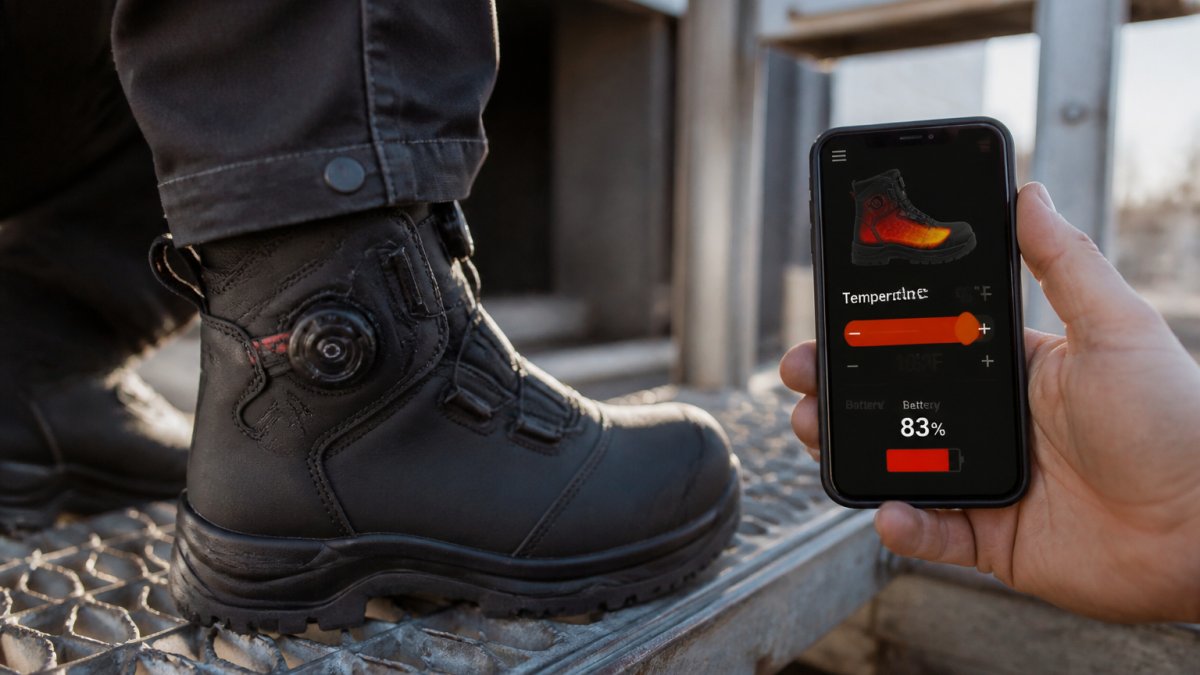
What the app actually controls
A useful app-controlled heated boot gives you control over four things:
- Target temperature, Most systems let you set a specific degree target rather than only low/medium/high. A common working range is roughly 90°F to 120°F at the footbed, with the upper end reserved for stationary work in deep cold. Presets give you less ability to trade warmth for runtime.
- Heat zones, Better boots heat the insole and upper separately or together. Toe-only heat leaves the top of the foot cold; full-foot heat is more comfortable but drains battery faster. Look for independent zone toggling.
- Runtime mode, Many apps include an "eco" or "extended" mode that caps peak output to stretch battery life across a 10-hour shift, the most useful feature for workers who can't recharge mid-shift.
- On/off and lock, A lock prevents accidental activation in a pack or vehicle, and a hard off switch matters when you store boots for the season.
Warm-up time and heat distribution
Heating elements are typically thin resistive wires or carbon-fiber pads woven into the insole and side panels.
Heat distribution separates comfort from hot spots. A boot heating only the sole leaves toes and instep cold; one heating the insole plus toe box and side panels distributes warmth more evenly, reduces burn risk, and holds a more consistent temperature. Ask where the elements are placed, not just the wattage.
App compatibility, connectivity, and offline control
Before buying, confirm three things about the app itself:
- Operating system support, Check that the app runs on your phone's current OS version and that the manufacturer updates it. An app untouched for two years may stop working after your next phone upgrade.
- Bluetooth range and reliability, Bluetooth typically works within about 30 feet line-of-sight, less through walls or heavy clothing. If you adjust heat with your phone in a truck or locker, confirm the boot also has a physical button or dial as a fallback.
- Offline control, Some apps require an internet connection to change settings, which is a problem on remote job sites. Look for a boot that stores your last settings on the boot itself so it keeps heating even if your phone dies or loses signal.
Privacy and data practices
If the app requests location, contacts, or background Bluetooth permissions, read the privacy policy first. Location data is the main concern: some systems use GPS for worker safety and fleet tracking, a feature for employers, a privacy issue for individual buyers. Confirm whether tracking can be disabled, where data is stored, and whether it's sold or shared. A boot that works fully offline with no account is the simplest privacy posture.
Overheating safeguards
Quality systems include overheat protection that reduces or cuts heating if surface temperature exceeds a safe threshold. The app usually shows real-time battery status and heat output, and low-battery alerts give you time to find shelter or switch to a backup pair. Workers with reduced foot sensation, people with diabetes, for example, should consult a healthcare provider first, because they may not feel a developing hot spot.
What to test in the first week
Evaluate any app-controlled heated boot with a structured first week: wear it indoors at a moderate setting to learn the app, then run a full shift outdoors at your normal working temperature and log battery life at each heat level. That log beats any spec sheet.
Heated Boots Battery Life: Runtime, Charging, and Real-Shift Performance
Battery life is where app-controlled heated boots either deliver or disappoint, and it's the spec most buyers misread. Manufacturer runtime claims are usually measured at moderate temperatures and heat settings. In extreme cold at maximum heat, runtimes drop sharply, a boot rated for 8 hours may deliver 4-5 at full heat in minus 20°F weather, because elements work harder against a greater temperature differential.
How to read a runtime claim
A useful way to compare systems is to ask the manufacturer for runtime at three heat levels, not one. If they only publish a single number, assume it's the best-case figure:
- Low / eco mode, Often 8-12 hours on a full charge. This is the mode to use for a full 10-hour shift in moderate cold.
- Medium, Typically 5-8 hours. The default for active work in sub-freezing conditions.
- High / max, Often 3-5 hours. Reserve this for breaks, stationary tasks, or extreme cold.
If a manufacturer can't give you numbers at each level, that's a signal the system is designed around a single marketing figure rather than real shift use.
Charging time and logistics
Charging time typically ranges from 2-4 hours, depending on battery capacity and charger type; most systems use USB-C or a proprietary connector. For workers managing multiple pairs, charging one overnight while wearing another is a practical necessity. Some premium systems fast-charge in 60-90 minutes, at a higher price.
Two logistics questions matter more than the headline charge time:
- Can you charge from a vehicle or power bank? USB-C charging lets you top up from a truck outlet or a portable battery, which is often more useful on a job site than a wall charger.
- Does the boot charge while in use? Some systems allow pass-through charging, which can extend a shift if you have access to power. Others require the battery to be removed.
Battery placement and weight
Battery placement affects comfort and runtime. Heel-mounted batteries keep weight low and centered for better balance on uneven ground; arch-mounted ones are less noticeable but limit capacity. Some systems use a removable pack that swaps mid-shift, a spare doubles runtime without a second pair of boots.
Replacement batteries and long-term cost
Battery replacement is a critical consideration most buyers overlook: after roughly 300-500 charge cycles, capacity typically drops 20-30%. Before buying, confirm:
- Are replacement batteries available? A boot system that becomes unusable because replacement batteries are discontinued is an expensive mistake.
- What do they cost? Factor the replacement cost into your total cost of ownership over 2-3 years.
- Are they user-replaceable? A battery you can swap yourself extends the boot's life; a sealed battery may mean sending the boot in for service.
Real-shift habits that extend runtime
Workers who run maximum heat continuously drain batteries faster than those who modulate. Experienced users run moderate heat during active work and bump to maximum only during breaks or stationary tasks, a habit that can extend battery life by 30-40%.
A simple first-shift test
On your first cold-weather shift, run the boot at medium heat and note when the low-battery alert appears. That single data point gives you a baseline for planning the rest of the season.
Safety Certifications: Heated Safety Boots with CSA Z195 and ASTM F2413
For industrial and construction work, safety certifications are legal requirements in most jurisdictions.
Adding heating changes a boot's electrical properties, so a boot certified before integration isn't automatically safe after it.
Verify that certification applies to the heated model specifically, not just the base boot design.
E-BOOTS™ safety boots carry CSA Z195 and ASTM F2413 certification for their complete heated systems, meaning the certification covers the heating elements, battery integration, and app connectivity alongside traditional safety features.
Key Features to Compare: Waterproofing, Insulation, and Heat Distribution
When comparing app-controlled heated safety boots, focus on three technical features that determine real-world performance: waterproofing, insulation quality, and heat distribution design.
Waterproofing protects both your feet and the electrical system. Look for sealed seams, waterproof membranes (like Gore-Tex), and sealed battery compartments, water ingress corrodes heating elements and batteries, causing safety hazards and system failure.
Insulation works alongside heating to maintain warmth.
Heat distribution determines comfort and safety.
Also worth evaluating: removable heated liners for washing, adjustable fit systems that work with heated components, and app interfaces showing real-time temperature and battery status.
Common Concerns: Safety, Privacy, and Long-Term Durability
Workers considering app-controlled heated boots raise legitimate concerns about burn risk, data privacy, and long-term durability.
Burn risk is real but manageable.
Privacy concerns around GPS tracking and app connectivity are valid: if your boots include GPS, that location data exists somewhere, on your phone, a company server, or both.
Long-term durability depends on maintenance. Heating elements, batteries, and app connectivity add complexity, and boots exposed to extreme abuse (repeated drops, crushing loads, extended submersion) fail faster than those used normally.
Choosing app-controlled heated safety boots means balancing performance, cost, and your work environment, shift length, ambient temperature, and whether your work requires CSA Z195 or ASTM F2413 certification. E-BOOTS™ heated safety boots deliver app-controlled temperature management, GPS tracking for field safety, and full workplace safety certifications, making them a strong choice for construction crews, utility workers, and industrial teams managing sub-zero conditions. Join the waitlist to stay updated on availability.
Frequently Asked Questions
Are app-controlled heated safety boots worth buying for construction work?
App-controlled heated safety boots deliver consistent warmth across long shifts in freezing conditions, which standard insulated boots cannot match. For construction workers and tradespeople operating in sub-zero temperatures, the ability to adjust heat on demand prevents cold-related fatigue and maintains focus. If your work involves extended exposure to cold and your employer covers safety footwear, the investment pays for itself in productivity and comfort. However, for occasional winter work, traditional insulated safety boots may suffice.
How long does the battery actually last in heated safety boots during a full work shift?
Battery runtime in heated safety boots depends on heat setting and ambient temperature. Higher settings reduce runtime. Check the manufacturer's published runtime data at each temperature setting, not just marketing claims.
What's the difference between heated boots and heated socks for cold-weather work?
Heated boots integrate heating elements into the boot sole and upper, distributing warmth across the entire foot and maintaining it consistently. Heated socks rely on external warmth and can lose effectiveness quickly. Heated boots with app control let you adjust temperature throughout the day, while heated socks offer no customization. For workers in extreme cold or long shifts, heated boots provide superior performance, better battery efficiency, and more reliable heat retention than heated socks alone.
Do heated safety boots with CSA Z195 certification actually protect your feet in industrial environments?
CSA Z195 and ASTM F2413 certifications confirm that a boot meets impact, compression, and puncture-resistance standards required for construction and industrial work. These certifications are independent testing requirements, not marketing claims. When choosing heated safety boots, verify the certification applies to your specific boot model and matches your workplace hazards. Heating elements do not compromise safety protection when properly integrated; the heating system operates independently of the toe cap and midsole protection.


