

Buy Industrial Grade Heated Work Boots: 2026 Guide
Table of Contents
- What Industrial Buyers Look For in Heated Work Boots
- How Heated Work Boots Work
- Insulated Work Boots vs Heated Boots: Which Does Your Shift Need?
- Composite Toe Heated Work Boots and Toe Protection Options
- Waterproof Winter Work Boots for Snow, Slush, and Mud
- What It Costs to Outfit a Crew in Heated Work Boots
- Conclusion
- Frequently Asked Questions
Last Updated: October 16, 2026
What Industrial Buyers Look For in Heated Work Boots
Shopping for industrial grade heated work boots starts with one question most buyers never ask: what kind of protection does your shift actually require? At E-BOOTS™, we build heated work boots for crews and tradespeople who spend long hours in serious cold, so we think about this constantly. The boots that keep a warehouse worker comfortable are not the same boots that survive a utility trench in January. Get the category wrong and no amount of heating fixes it.
Three things get blended together in product listings, and they should not be. Here is the distinction that matters most:
- Heating means the boot generates warmth, usually from a rechargeable battery and a heating element.
- Insulation means the boot traps the heat your foot already produces. No battery involved.
- Heat resistance means the boot's materials resist damage from external heat, such as a hot surface or molten splash. It has nothing to do with keeping your feet warm.
How Heated Work Boots Work
A heated work boot runs on a rechargeable battery that powers a heating element built into the boot. Most designs let the wearer pick a heat level, and the better ones regulate that heat automatically as conditions change.
That last part separates a good system from a frustrating one. A boot that runs at one fixed output drains its battery whether you need the warmth or not. A boot with on-board sensors can raise and lower heat as the ambient temperature shifts, which is how our platform is designed to work.
A few practical points apply to any brand:
- Battery-powered heat adds weight, so fit matters more than it does in an unheated boot.
- Cold drains batteries faster than mild weather does. Plan charging around your shift.
- Heating elements sit under the foot or around the toe box. Poor fit means poor heat transfer.
For a broader look at how cold affects workers and what protective equipment is designed to do, the Canadian Centre for Occupational Health and Safety guidance on cold environments is a useful starting point.
Insulated Work Boots vs Heated Boots: Which Does Your Shift Need?
Insulated work boots trap body heat. Heated work boots add heat. The right choice depends on how long you are outside and how cold it gets.
| Your situation | Better starting point | Why |
|---|---|---|
| Short outdoor stints, frequent warm-up breaks | Insulated work boot | Body heat plus insulation is enough |
| Full shift outdoors in freezing conditions | Heated work boot | Adds warmth instead of only trapping it |
| Standing still for long periods | Heated work boot | Little body heat is generated when you are not moving |
| Mixed indoor and outdoor work | Insulated work boot | Less bulk and no charging routine |
| Extreme cold, remote locations | Heated work boot | Heat source plus insulation works together |
If your feet run cold no matter what you wear, insulation alone rarely solves it. That is the case where a heated boot earns its place.
Composite Toe Heated Work Boots and Toe Protection Options
Composite toe heated work boots use a non-metallic protective toe cap. Composite toes are lighter than steel and do not conduct cold the way metal does, which is why they show up often in cold-weather work footwear.
The trade-offs are worth knowing:
- Steel toe: Traditional, very strong, and cold to the touch in freezing conditions.
- Composite toe: Lighter, does not transfer cold, and common in winter work boots.
- Metatarsal guard: Extends protection across the top of the foot, not just the toe. Adds bulk.
Both of our work and safety models, the ForgeTherm Pro and the Ironclad WorkOne, use a lightweight composite protective toe. The ForgeTherm Pro is our high-cut design built for industrial conditions, while the Ironclad WorkOne keeps a classic leather work-boot profile for people who want a familiar shape on the jobsite.
Waterproof Winter Work Boots for Snow, Slush, and Mud
Waterproof winter work boots keep liquid water out, and that matters because wet insulation stops insulating. A soaked boot loses most of its ability to hold warmth, no matter how good the insulation is.
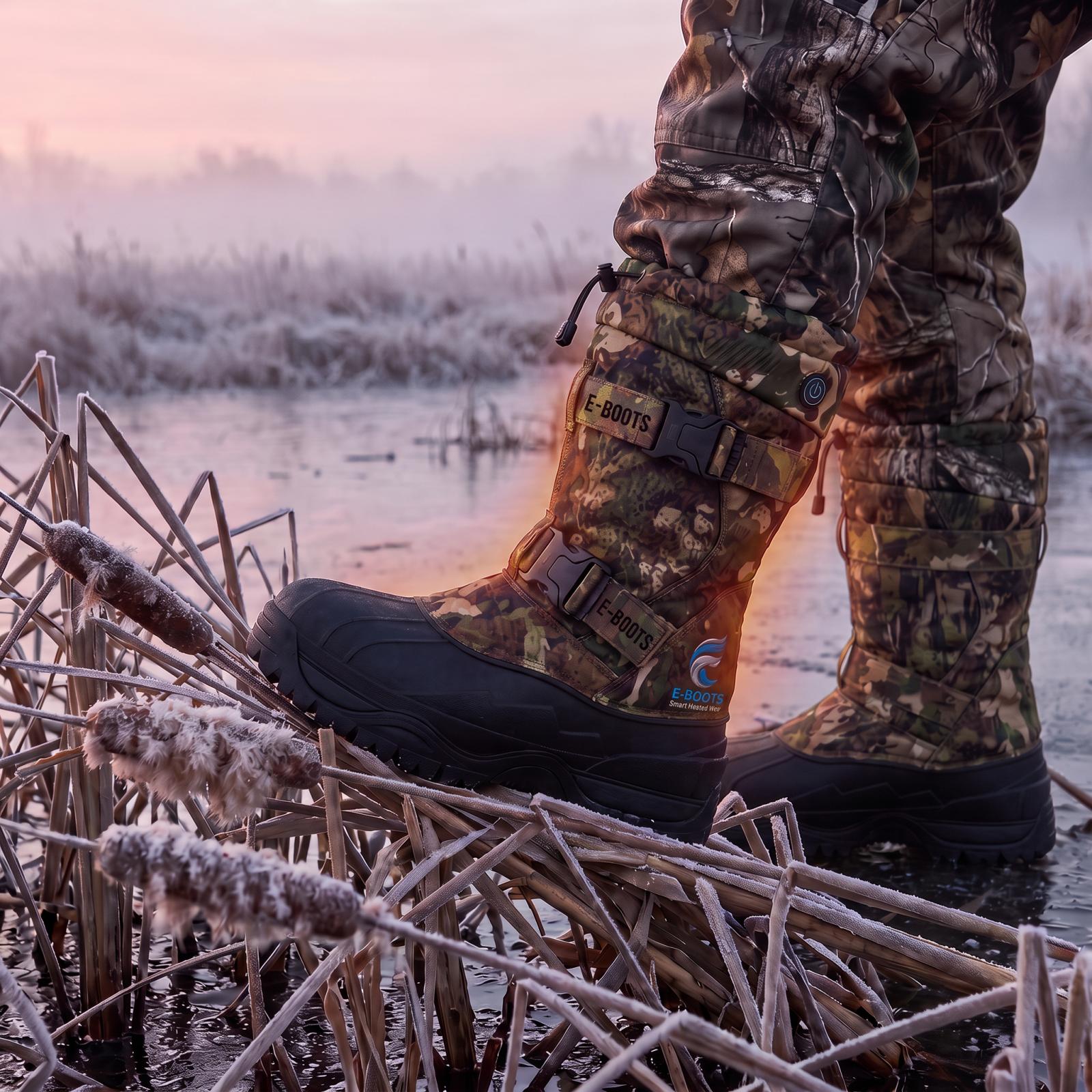
Look for three things in a winter work boot:
- A sealed, waterproof construction, not just a water-resistant coating that wears off.
- A tall cut that shields the lower leg from snow, slush, and mud kicked up on site.
- An outsole with real tread depth for traction on packed snow and ice.
Our boots are built with rugged waterproof construction and outsoles intended for difficult ground. On fit, dual adjustable straps are designed to create a secure hold over layers, which helps when you are wearing thicker socks in deep winter.
Care, Cleaning, and Safe Charging
This is the part most buying guides leave out, and it is the part that decides whether a heated boot lasts more than one season.
- Clean mud and salt off before they dry. Road salt and jobsite mud pull moisture into seams and can break down waterproof treatments over time. A soft brush and cool water handle most of it.
- Never machine wash or tumble dry a heated boot. The heat and agitation can damage the heating element, the wiring, and the waterproof membrane. Air dry at room temperature, away from radiators and direct sun.
- Pull the liner or footbed out to dry separately where the design allows it. Trapped moisture between layers is what shortens the life of insulation.
- Charge at room temperature, not in a cold truck. Cold slows the chemical reaction inside a lithium battery, so a battery charged in freezing conditions may not reach full capacity. Bring batteries inside to charge.
- Do not charge a wet boot. Wipe the charging port and the battery contacts dry before connecting anything, and never leave a battery on a charger unattended overnight in a damp space.
- Store boots with the battery removed if the boot will sit for weeks. A battery left in a cold, unused boot for a full off-season is the most common way a heated boot arrives at the next winter already weak.
A simple routine works for most crews: brush off the mud at the end of the shift, pull the liners, set the boots to air dry, and put the batteries on the charger indoors. That is five minutes at the end of a shift, and it is the difference between a boot that is ready in November and a boot that is not.
What It Costs to Outfit a Crew in Heated Work Boots
Heated work boots sit above conventional work boots on price, and the gap comes from the battery, the heating element, and the electronics. There is no single figure that covers every brand, because cost depends on the model, the quantity you order, and whether replacement batteries are part of the plan.
For employers, think in four cost layers rather than one:
- The boot itself, priced per person and per model. A high-cut industrial design and a classic leather profile will not land at the same number, and neither will a heated model versus an unheated one.
- Spare batteries, so a crew is never stranded mid-shift waiting on a charge. This is the line item most first-time buyers forget, and it is the one that turns a single purchase into a system.
- Charging infrastructure, meaning enough outlets, charging cables, or a designated charging station where batteries can be topped up between shifts without being left in a cold truck overnight.
- Replacement over time, since batteries and liners wear before the boot shell does.
A common pattern in industrial purchasing is to compare two boots on the per-pair number alone, then discover in year two that the cheaper pair needed new batteries twice while the more expensive pair is still on its original set. The cheapest boot per pair is rarely the cheapest boot per winter.
We do not publish pricing yet, because we are pre-launch. When we do, current pricing and any crew or bulk options will be listed on our site, so check there rather than relying on a number from a third party.
Conclusion
Outfitting a crew for serious cold is a real budget decision, and the wrong category of boot wastes money no matter what you pay. Match the protection to the job, then decide whether you need heating, insulation, or both. E-BOOTS™ is building heated work boots with dual-control heating, app connectivity, GPS features, and a lightweight composite protective toe in our work and safety line, designed for people who work through the cold rather than around it. Join the early-access waitlist at e-boots.com and be first in line when our work and safety boots become available.
Frequently Asked Questions
How do heated work boots work?
Heated work boots use integrated heating elements powered by a rechargeable battery, with adjustable heat settings the wearer controls on the boot itself or through a phone app. On-board sensors can raise and lower heat as the ambient temperature changes, which helps hold comfort while protecting battery runtime. The E-BOOTS platform adds dual-control heating and secure custom Bluetooth, so warmth can be adjusted without stopping work. Heating sits alongside insulation and waterproofing rather than replacing them, so the whole build matters, not just the element.
What should I look for when buying heated work boots for industrial work?
Start with the protection your site requires, then work outward. Look at toe type (composite or steel), whether a met guard is needed, slip-resistant outsoles, and waterproof construction. Then check the heating side: adjustable heat settings, how the battery recharges, and whether controls work through an app. For crews, ask how the boots are designed to fit over thick cold-weather socks, since sizing with layers changes the feel. E-BOOTS builds its work and safety line with a lightweight composite protective toe and dual-control heating.
Are heated work boots suitable for long shifts in cold weather?
They are designed for exactly that use case. The key detail is battery runtime and how the heating is managed: boots that regulate heat from ambient sensors are intended to avoid running at full power the whole shift, which helps protect battery life. E-BOOTS does not publish a runtime figure for its pre-launch models, so treat any specific hour count from any brand as something to verify against that brand's own documentation before you commit a crew to it.
What is the difference between heated work boots and insulated work boots?
Insulated work boots trap body heat using materials like Thinsulate or felt, and they have no power source. Heated work boots add a battery-powered element that generates warmth, usually with adjustable heat settings and sometimes app control. Insulation is passive and depends on how much you move; heating is active and can be raised or lowered. Many cold-weather builds combine both, using thermal insulation as the base layer of warmth and heating to top it up during stationary work.
How should industrial work boots fit with cold-weather socks?
Bring the socks you actually wear on shift when you size, or size to that thickness. A boot that fits snugly over a thin sock can restrict circulation over a thick merino or thermal sock, and restricted circulation makes feet colder, not warmer. You want a thumb's width at the toe and a heel that does not lift. If you plan to add heated insoles, account for the space they take up. Dual adjustable straps on tall designs help fine-tune the fit over layers.


