

Are Heated Boots Safe for Daily Industrial Use
Last Updated: October 23, 2026
Quick Summary
Yes, are heated boots safe for daily industrial use when they're engineered for industrial conditions with proper electrical isolation, thermal protection, and durability. Safety depends on sealed battery compartments, automated temperature regulation, and a daily inspection and maintenance routine that includes checking for damage, drying boots fully after each shift, and charging batteries overnight.
- Check battery compartments, heating elements, and boot linings daily before use to catch damage early
- Remove batteries after each shift and dry boots completely in a cool place for at least 24 hours
- Heated boots must meet CSA Z195 or ASTM F2413 safety standards for industrial work environments
- Wear moisture-wicking socks and use automated heating rather than constant maximum heat to prevent excessive sweating
- Battery runtime extends through automated climate regulation that adjusts heat based on ambient temperature rather than running at full power all day
Table of Contents
- How Heated Boots Work and What Safety Means in Industrial Settings
- Heated Boots Safety: Electrical Hazard Protection on the Jobsite
- Heated Boots vs Heated Socks: Which Fits Industrial Work
- Cold-Weather PPE for Industrial Workers: Heated Boots in Your Safety Program
- Daily Use Best Practices: Inspection, Maintenance, and Crew Responsibility
- When Heated Boots Make Sense for Your Team
- Conclusion
- Frequently Asked Questions
How Heated Boots Work and What Safety Means in Industrial Settings
Heated boots are designed to keep feet warm in extreme cold by combining insulation with active heat generation.
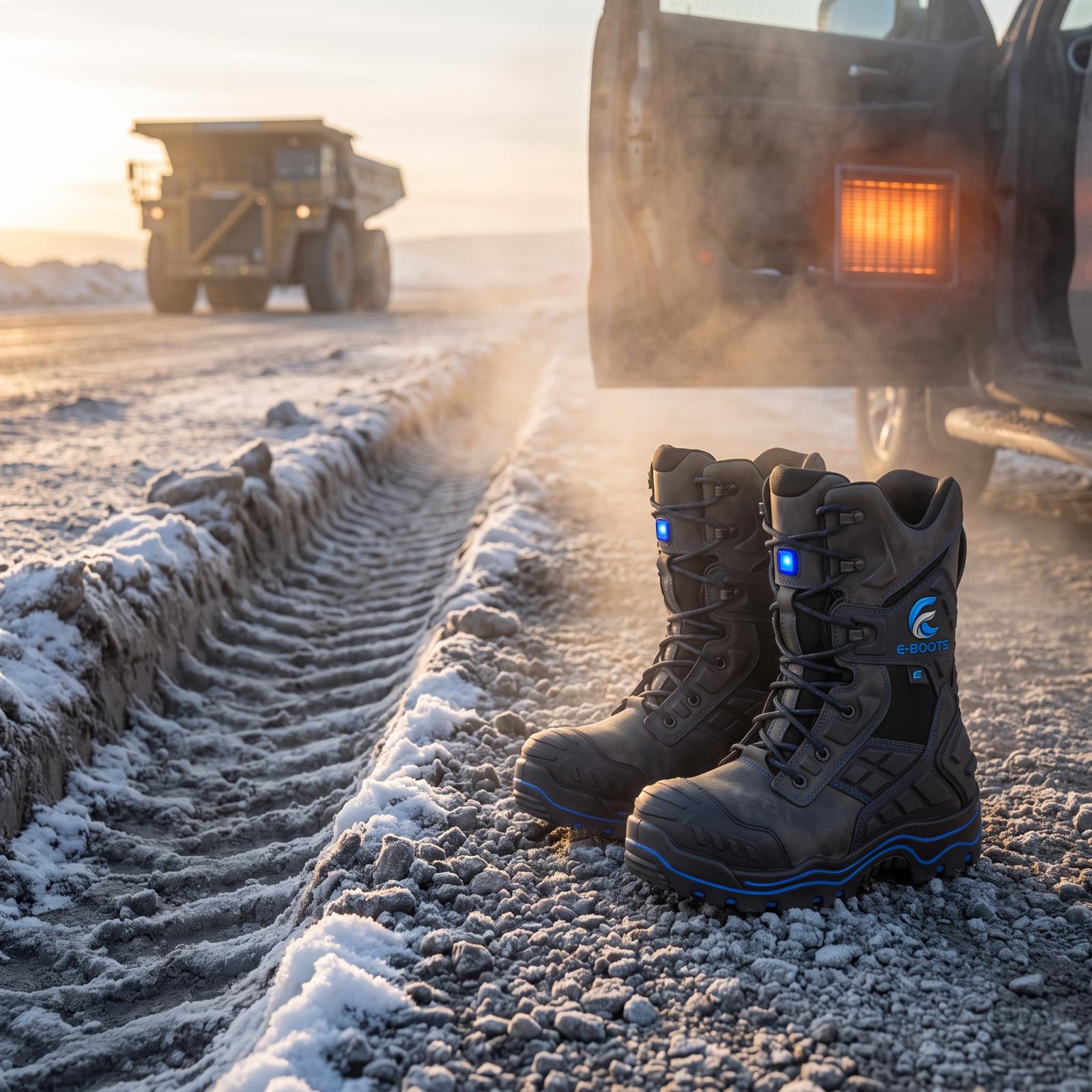
At E-BOOTS, we've built heated boots around industrial realities. Construction crews, oilfield teams, and utility workers spend hours in temperatures where ordinary boots give up.
The answer depends on how the heating system is built and how it's used on the jobsite.
The heating element and power system
A heated boot contains three core components: a heating element (usually a resistive wire or ceramic pad), a battery pack (typically lithium-ion), and a control system that regulates temperature. The element sits inside the boot against the insole or footbed, warming your foot without direct skin contact.
The battery is the critical piece for industrial safety. It needs to be:
- Isolated from moisture and jobsite conditions
- Protected against impact and crushing
- Designed to shut down if damaged
A poorly sealed battery in a wet, muddy, or chemically harsh environment becomes a liability. Water ingress can cause short circuits. Impact damage can trigger thermal runaway.
E-BOOTS heated work boots use sealed battery compartments and circuit isolation specifically because jobsites aren't controlled environments. The ForgeTherm Pro and Ironclad WorkOne are designed to handle the conditions where industrial crews actually work.
Temperature control and automated regulation
Manual heating can be dangerous. Set the temperature too high and leave it there, and you risk burns.
That's why automated climate regulation matters for safety. E-BOOTS boots use on-board sensors that measure ambient temperature and adjust heat automatically.
This design approach does two things:
- Reduces user error (you don't have to manually adjust heat all day)
- Prevents overheating (the system won't cook your feet at a fixed high temperature)
The app-connected dual-control system lets you adjust warmth remotely or on the boot itself, giving you flexibility without requiring constant attention to the heating settings.
Heated Boots Safety: Electrical Hazard Protection on the Jobsite
Electrical safety in heated boots comes down to isolation and design. Your feet are in contact with the boot all day. If there's any path for current to reach your skin, that's a hazard.
Battery and circuit isolation
Industrial environments present electrical challenges that don't exist in casual use: conductive materials, wet conditions, or equipment that generates electrical fields.
E-BOOTS heated work boots use several isolation strategies:
- Sealed battery compartments designed to prevent moisture and conductive materials from reaching the power system
- Non-conductive boot materials in areas where electrical contact could occur
- Circuit design intended to prevent current leakage even if the battery casing is compromised
The goal is simple: the heating system is designed to avoid becoming a path for electrical current into your body.
Research from the Journal of Occupational and Environmental Medicine has examined how footwear design affects worker safety and performance.
Skin contact and thermal burn risk
A heated element inside a boot will warm your foot. The question is whether it can cause burns.
That said, if a heating element is damaged or the boot is compromised, risk increases. This is why daily inspection matters.
Where risk is relevant, we say that proper design helps reduce the risk rather than claiming it prevents harm entirely. The heating system is one part of a boot's safety profile.
Heated Boots vs Heated Socks: Which Fits Industrial Work
Heated socks and heated insoles are cheaper and easier to swap between boots. But they're not the same as heated boots, and for industrial crews, the differences matter.
Integration, durability, and jobsite conditions
Heated socks and insoles are add-ons. You buy them separately, insert them into regular boots, and hope they stay in place through a long shift.
Heated boots integrate the heating system into the boot structure itself. The element, battery, and controls are built in, sealed against moisture, and designed to survive the jobsite.
E-BOOTS work and safety boots treat heating as a core feature, not an afterthought.
Battery runtime and shift length
Battery life is where the difference becomes practical.
Heated socks typically run 4 to 8 hours on a charge. Heated insoles often run 6 to 10 hours. Industrial shifts can run 8, 10, or 12 hours in winter conditions. If your battery dies at hour 6, you're cold for the rest of the day.
Integrated heating systems in boots can be optimized for longer runtime because they're built into the design.
Automated regulation is the key difference. The system doesn't run at full heat all day. It adjusts based on ambient temperature.
For a crew working a long industrial shift, this difference is real. You need heat that lasts the whole day, not heat that fails halfway through.
Cold-Weather PPE for Industrial Workers: Heated Boots in Your Safety Program
If you're managing a crew in extreme cold, heated boots aren't just a comfort upgrade. They're part of your occupational health strategy.
Compatibility with protective footwear standards
Industrial workers in Canada and the US need boots that meet CSA Z195 or ASTM F2413 standards, which cover protective toe, electrical hazard protection, and other safety requirements.
E-BOOTS ForgeTherm Pro and Ironclad WorkOne both meet CSA Z195 and ASTM F2413 standards.
When you're evaluating heated boots for your team, ask:
- Does the boot meet the safety standards your workplace requires?
- Is the protective toe compatible with the heating system?
- Are the electrical isolation features adequate for your jobsite?
This is where industrial-grade design matters. Consumer heated boots often skip safety certifications entirely. Work boots need them.
Moisture, sweat, and foot health during long shifts
Heat plus moisture equals problems. If your feet sweat inside a heated boot and that sweat has nowhere to go, you end up with wet socks, blisters, and cold feet, because wet feet lose heat fast.
E-BOOTS heated work boots are designed with moisture-wicking footbeds and breathable linings that are intended to move sweat away from your skin. This is designed to help reduce excessive sweating while helping to keep your feet warm.
Best practice for crews:
- Wear moisture-wicking socks, not cotton
- Choose boots with breathable linings
- Use automated heating, not constant maximum heat
The boot is part of the system. The socks, the fit, and how you layer all matter equally. Heated boots work best when they're part of a complete cold-weather strategy.
Daily Use Best Practices: Inspection, Maintenance, and Crew Responsibility
Heated boots need more attention than regular boots. The heating system adds complexity. If something goes wrong, you need to catch it before it becomes a safety issue.
Pre-shift and post-shift checks
Every day before you put on heated boots, spend two minutes on inspection:
- Check the battery compartment for cracks, water, or corrosion
- Look at the heating element area for visible damage or exposed wiring
- Test the heating system (turn it on, feel for warmth, turn it off)
If you find damage, don't use the boot. Report it. A cracked battery compartment or exposed heating element is a hazard.
After your shift:
- Remove the battery if your boots have removable batteries
- Let the boots dry completely (not near direct heat)
- Wipe down the exterior to remove mud, salt, or chemicals
This routine takes 5 minutes and prevents most problems. It also gives you a chance to catch damage early, before it becomes unsafe.
Drying, storage, and battery care
Moisture is the enemy of heated boots. Water inside the battery compartment, around the heating element, or in the insulation creates electrical hazards and degrades materials.
Drying protocol:
- Remove insoles and let them air dry separately
- Stuff the boot with newspaper to absorb moisture (change the paper if it gets wet)
- Leave the boot in a cool, dry place for 24 hours minimum
Battery care:
- Charge the battery fully after each shift
- Store the battery in a cool place (not in a hot truck or direct sunlight)
- Don't let the battery fully discharge for extended periods
A crew manager should set clear expectations. Every worker gets a designated drying area. Boots are inspected before the next shift. Batteries are charged overnight. This routine prevents most failures and keeps the crew safe.
When Heated Boots Make Sense for Your Team
Heated boots aren't for every situation. They're designed for specific conditions where cold is the limiting factor.
Heated boots make sense if:
- Your crew works outdoors in temperatures below freezing regularly
- Shifts run 8+ hours in extreme cold
- Cold feet reduce productivity or create safety risks
Heated boots don't make sense if:
- Your crew works indoors or in mild climates
- Shifts are short enough that regular insulation is sufficient
- Budget constraints make the upfront cost prohibitive
The decision should involve crew input, because workers know what they need. If your team is struggling with cold feet, losing productivity, or working through pain, heated boots designed for industrial conditions are built to help change that day. E-BOOTS ForgeTherm Pro and Ironclad WorkOne are built for crews that work in extreme cold as part of their job.
Conclusion
Are heated boots safe for daily industrial use? The answer is yes, but only if they're engineered for industrial conditions and used with a clear maintenance routine.
Safety depends on electrical isolation, thermal protection, durability, and crew accountability.
The boots also need daily inspection, proper drying, and battery care. This isn't optional. It's the foundation of safe use.
If your crew works long shifts in extreme cold, heated boots designed for industrial conditions are built to help reduce the risks of cold exposure while helping to keep your team productive and safe.
Frequently Asked Questions
Are heated boots safe to wear for a full work shift?
Heated boots are designed to help manage foot warmth during long industrial shifts when built with proper electrical isolation and temperature controls. Safety depends on selecting boots from manufacturers that prioritize circuit protection, use insulated heating elements, and are designed to include automatic shutoff features. Inspect your heated boots before each shift for damage to the battery compartment, heating element, or wiring. If you notice cracks, exposed wires, or corrosion, do not use the boots until they are repaired or replaced. Follow your employer's approval process and maintenance routine.
What should workers check before using heated boots on an industrial jobsite?
Before wearing heated boots, verify that the battery is fully charged, the heating element powers on and off as expected, and there are no visible cracks or damage to the boot shell or electrical components. Check that the boot meets your workplace's required protective standards, such as CSA Z195 or ASTM F2413 for safety footwear. Ensure the fit is secure with proper layering underneath, and confirm that your employer has approved heated boots as part of your cold-weather PPE program. Store boots in a dry location between shifts and charge the battery according to the manufacturer's guidelines.
How do heated boots compare to heated socks for cold-weather work?
Heated boots integrate the heating element and battery into the boot structure itself, designed to offer durability and consistent performance across long shifts and demanding jobsite conditions. Heated socks are standalone accessories that can wear out, slip, or lose contact with your feet inside a regular boot. For industrial work where durability, fit, and reliability matter, heated boots designed for the jobsite are designed to provide better integration with required protective footwear and more stable heat delivery. Heated socks work best as a temporary supplement rather than a primary solution for extended cold-weather shifts.
Can heated boots be worn with required protective work footwear?
Heated boots designed for industrial use are built to meet protective footwear standards such as CSA Z195 and ASTM F2413, which include requirements for protective toe caps, slip resistance, and impact protection. When selecting heated boots for your jobsite, confirm that the model meets your workplace's specific safety requirements before purchase. Work with your safety team or employer to ensure that the boot's heating system does not interfere with protective features and that the overall design supports the physical demands of your role.
Join the early-access waitlist at e-boots.com to learn more about how E-BOOTS heated work boots are designed for crews working in extreme cold.


